EXECUTIVE SUMMARY & DOSSIER OVERVIEW
-
The Legal Crosshairs: An exhaustive, deep-dive investigation into the sudden and severe legal jeopardies currently enveloping Senator Rodante Marcoleta.
Amidst a wave of executive-led anti-graft offensives, highly credible intelligence indicates that the Office of the Ombudsman is finalizing airtight indictments against Marcoleta for plunder, malversation of public funds, and indirect bribery. -
The Question of Incarceration (Makukulong Din Siya?): The central political question dominating the Philippine capital is whether Marcoleta—the chief architect of the Senate’s controversial rules amendments—will find himself behind bars.
The trajectory of the evidence suggests that non-bailable warrants of arrest may be issued imminently by the Sandiganbayan. -
The Flood Control Nexus: A forensic mapping of the multi-billion-peso national flood control anomaly.
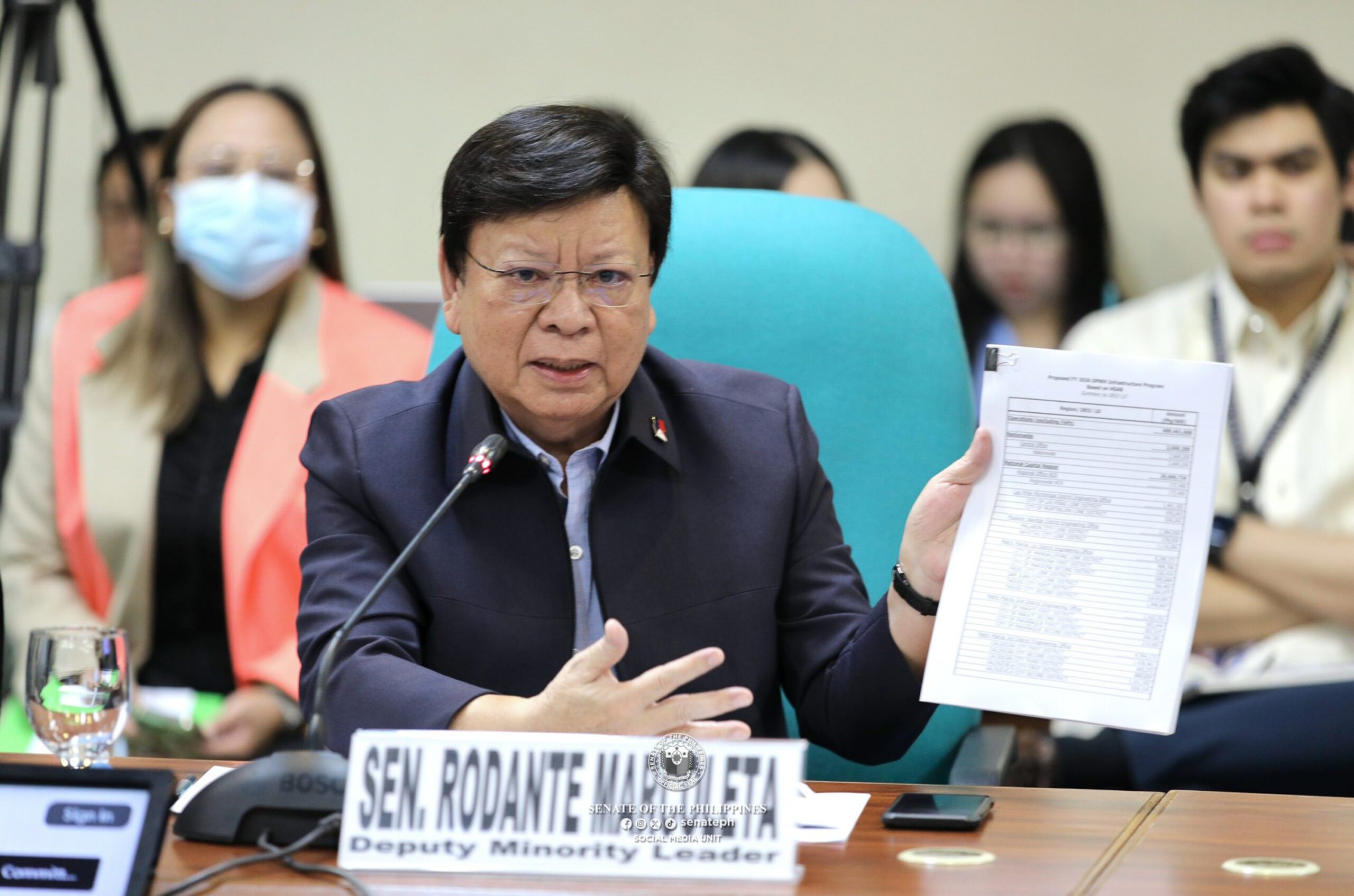
Investigative panels have allegedly traced sophisticated financial pipelines linking Marcoleta’s legislative maneuverings to ghost infrastructure projects and illicit kickbacks, severely compromising his posture as an uncompromising legal moralist.
-
The Irony of Rule 14: A critical analysis of Marcoleta’s desperate, highly controversial push to insert Section 41-C into the Senate Rules.
Framed initially as an institutional modernization effort, the attempt to legalize “virtual attendance” is now widely interpreted as a preemptive survival strategy—a digital escape hatch engineered by a lawmaker who foresaw his own impending detention. -
The Collapse of Hubris: An exploration of the psychological and political downfall of a senator who recently mocked his colleagues for their lack of a “legal background,” only to find himself entangled in a legal web that no amount of parliamentary grandstanding can undo.
SECTION I: THE GATHERING STORM—THE LEGAL JEOPARDY OF RODANTE MARCOLETA
The Transition from Predator to Prey
In the ruthless and hyper-accelerated arena of Philippine politics, the transition from apex predator to hunted prey can occur in the span of a single legislative week.
Senator Rodante Marcoleta, a veteran political operator known for his aggressive rhetoric and lethal deployment of technical parliamentary procedures, is currently facing the most severe existential crisis of his political career.
The digital ecosystem is ablaze with a singular, terrifying question for the administration’s allies: “Makukulong din siya?” (Will he be jailed too?).
For months, Marcoleta operated with an aura of untouchability.
As a vocal enforcer for the Cayetano-led Senate majority and a staunch defender of the Duterte-aligned political faction, he positioned himself as the ultimate legal gatekeeper of the upper chamber.
He was the man who dictated the interpretation of laws, the senator who confidently lectured his peers on the distinctions between lex specialis and general statutes.
However, the architecture of his invulnerability is rapidly disintegrating.
The Office of the Ombudsman, operating under the directive of Jesus Crispin “Boying” Remulla, has reportedly accelerated a series of high-level lifestyle checks, financial audits, and infrastructural investigations directly targeting Marcoleta.
The executive branch’s anti-graft machinery is no longer issuing warnings; it is drafting charging documenTS.
The charges reportedly being prepared are not minor administrative infractions.
They constitute capital offenses under the Philippine penal framework:
-
Plunder (Republic Act No.
7080): Accumulation of ill-gotten wealth exceeding PHP 50 million through a combination or series of overt criminal acTS. This is a non-bailable offense punishable by reclusion perpetua. -
Malversation of Public Funds (Revised Penal Code, Article 217): The misappropriation or consenting to the taking of public funds by a public officer accountable for them.
-
Indirect Bribery and Violation of the Anti-Graft and Corrupt Practices Act (Republic Act No.
3019): Utilizing his office to grant unwarranted benefits to private contractors in exchange for financial kickbacks.
The sudden realization that Marcoleta—the legal heavyweight of the majority bloc—might soon be photographed in a detention facility has sent shockwaves through the political establishment, forcing a complete recalculation of the Senate’s power dynamics.
SECTION II: THE FLOOD CONTROL SYNDICATE
Tracing the Billions in the Mud
To understand the gravity of the impending charges against Senator Marcoleta, one must delve into the murky, subterranean world of Philippine infrastructure spending—specifically, the national flood control program.
For decades, flood control budgets have served as the ultimate political slush fund.
Because the physical evidence of “dredging” or “desilting” is easily washed away by the next typhoon, auditing these projects is notoriously difficult.
Millions of cubic meters of mud and silt can be claimed on paper, paid for by the national treasury, and completely fabricated in reality.
The ongoing Senate Blue Ribbon Committee investigations, initially stalled but perpetually looming, have begun to uncover a systematic, syndicated plundering of these specific funds.
According to leaked intelligence from the inter-agency task force investigating the anomalies, Marcoleta is allegedly implicated in a highly sophisticated scheme involving:
-
Budget Insertions: Utilizing the bicameral conference committee to insert massive, unvetted budgetary allocations for flood control projects in specific, highly controlled congressional districTS.
-
The “Suki” Contractors: Directing the Department of Public Works and Highways (DPWH) to award these multi-million-peso contracts to a pre-selected consortium of favored construction firms.
-
The Phantom Deliverables: Approving certificates of completion for dredging projects that were either severely substandard or entirely non-existent.
The prosecution’s theory allegedly hinges on the testimony of mid-level district engineers and regional DPWH directors.
Facing the prospect of spending the rest of their lives in the New Bilibid Prison, several of these bureaucrats have reportedly turned state witness, providing sworn affidavits and financial ledgers that trace the kickbacks directly to legislative operators.
Marcoleta’s name has allegedly surfaced repeatedly in these whistleblower testimonies, transforming him from a legislator into a prime criminal suspect.
SECTION III: THE WEAPONIZATION OF THE OMBUDSMAN
A Calculated Executive Strike
The aggressive pursuit of Marcoleta cannot be viewed in isolation; it is part of a broader, surgically precise geopolitical and domestic strategy orchestrated by the executive branch.
The Malacañang Palace is currently facing a highly hostile, independent-minded Senate majority capable of blocking the administration’s legislative agenda and initiating devastating investigations.
By unleashing the Office of the Ombudsman against key figures in the Senate majority—specifically Senators Jinggoy Estrada, Joel Villanueva, and now Rodante Marcoleta—the executive is executing a classic decapitation strike.
This weaponization of anti-graft laws serves multiple strategic objectives:
-
Breaking the Numbers Bloc: A senator locked in a detention cell cannot physically participate in crucial floor votes, thereby diminishing the majority’s numerical advantage.
-
Neutralizing the Legal Enforcer: By taking down Marcoleta, the administration silences the majority’s most capable parliamentary tactician, leaving the coalition vulnerable to procedural ambushes.
-
The Impeachment Leverage: With Vice President Sara Duterte facing an impending impeachment trial, the executive requires a compliant Senate.
Threatening the judges (the senators) with their own incarceration is the ultimate form of coercion.
Marcoleta’s impending arrest is therefore not merely an act of judicial accountability; it is a profound act of political warfare.
The administration is signaling that no amount of senatorial privilege can protect a legislator from the crushing weight of the state’s prosecutorial machinery.
SECTION IV: THE IRONY OF RULE 14 AND THE “DIGITAL ESCAPE HATCH”
Preemptive Survival Disguised as Modernization
The revelation of Marcoleta’s deep legal jeopardy provides a stunning new context to the chaotic events that unfolded on the Senate floor on May 26, 2026.
During that session, Marcoleta aggressively pushed for the immediate passage of an amendment to Rule XIV, Section 41-C of the Standing Rules of the Senate.
This amendment sought to permanently legalize “virtual attendance” and “remote voting” via teleconferencing tools (Zoom, WebEx) for any senator under undefined “justifiable reasons.”
At the time, the minority bloc accused Marcoleta of railroading the rule change to protect fugitive Senator Ronald “Bato” Dela Rosa from an active International Criminal Court (ICC) warrant.
The opposition staged a dramatic walkout to break the quorum and halt the vote.
However, viewing the events through the lens of Marcoleta’s impending plunder charges, the narrative violently shifTS. Marcoleta was not merely acting as a loyal shield for Dela Rosa; he was fighting for his own political survival.
[The Strategic Subtext of Rule XIV Amendment]
                                 │
         ┌───────────────────────┴───────────────────────┐
         ▼                                               ▼
[THE PUBLIC JUSTIFICATION]                      [THE PRIVATE REALITY]
• Modernization of the Senate.

                  • Anticipation of non-bailable warranTS.
• Adaptation to post-pandemic technology.

       • The need to vote while in detention.


• Ensuring continuous legislative output.

       • Preserving majority numbers from a jail cell.
Marcoleta understood that the Sandiganbayan could issue a warrant for his arrest at any moment.
Plunder is a non-bailable offense.
If incarcerated at the PNP Custodial Center in Camp Crame, he would be physically barred from the Senate floor, effectively castrating his political power and weakening his coalition.
Section 41-C was his digital escape hatch.
If passed, Marcoleta could sit in a detention cell, log onto a laptop, and continue to wield his senatorial vote as if he were standing in the plenary hall.
His desperate, furious attempt to bypass committee hearings and force an immediate floor vote was the frantic maneuvering of a man who could hear the sirens approaching.
SECTION V: THE HUBRIS OF THE “LEGAL BACKGROUND”
A Shakespearean Fall from Grace
The tragedy of Rodante Marcoleta is magnified by his own staggering hubris.
Just days before the reality of his legal peril became public knowledge, Marcoleta engaged in a highly publicized, deeply condescending confrontation with Senator Risa Hontiveros.
During the debate over the rules amendment, Marcoleta patronized Hontiveros, asserting that it was impossible to have a rational discussion because she lacked a “legal background.” He flaunted his status as a member of the Philippine Bar, parading his knowledge of lex specialis and statutory construction as a weapon to belittle his non-lawyer peers.
“Mahirap po kasi kung wala pong legal background… po talaga pong mahirap magkaintindihan.” (It is difficult when there is no legal background… it is truly difficult to understand one another.)
This arrogance has now structurally backfired.
The Filipino public, intensely observant of political karma, has seized upon the irony.
The digital sphere is flooded with commentary pointing out that all the legal background in the world cannot save a politician from the consequences of documented plunder.
The very laws Marcoleta claimed to master are now the instruments of his undoing.
His elite legal education did not prevent him from allegedly leaving a paper trail of financial anomalies, nor did his mastery of parliamentary procedure stop the Ombudsman from securing state witnesses.
The “lawyer of the Senate” is about to become a defendant, forced to hire his own defense counsel to explain why millions in flood control funds vanished under his watch.
SECTION VI: MATRIX OF LEGAL VULNERABILITIES
The Statutory Breakdown of the Marcoleta Indictment
The table below deconstructs the specific legal statutes allegedly being deployed against Senator Marcoleta by the Office of the Ombudsman, outlining the mechanisms of the crime and the potential penal consequences.
| Statutory Violation | Mechanics of the Alleged Crime | Evidentiary Basis | Penal Consequence |
| Plunder (RA 7080) | Accumulation of over PHP 50M through a series of corrupt acts related to infrastructure budgeTS. | Sworn affidavits from DPWH whistleblowers; AMLC bank tracking data. | Reclusion Perpetua (Life imprisonment); Absolute perpetual disqualification from holding public office; Forfeiture of asseTS. |
| Malversation (RPC Art. 217) |
Misappropriating or consenting to the misappropriation of public funds designated for flood mitigation. | Forged Certificates of Completion; physical audits showing zero actual dredging work. | Reclusion temporal to Reclusion perpetua, depending on the amount; Perpetual special disqualification. |
| Anti-Graft (RA 3019, Sec 3e) | Causing undue injury to the government, or giving unwarranted benefits to private contractors through manifest partiality. | Bidding logs showing rigged procurement processes favoring “Suki” contractors. | Imprisonment of 6 to 15 years; Perpetual disqualification from public office. |
SECTION VII: THE DOMINO EFFECT—IF MARCOLETA FALLS, WHO IS NEXT?
The Fragmentation of the Duterte-Cayetano Coalition
The potential incarceration of Senator Marcoleta is not an isolated event; it represents the removal of a critical load-bearing pillar in the current Senate power structure.
If Marcoleta is placed in preventative detention, the ripple effects will decimate the majority coalition.
-
The Loss of the Floor Tactician: The Cayetano-led majority relies heavily on Marcoleta to counter the parliamentary tactics of veteran minority figures like Ping Lacson, Tito Sotto, and Kiko Pangilinan.
Without Marcoleta on the floor to invoke obscure rules and raise points of order, the majority will find itself constantly outmaneuvered. -
The Psychological Chilling Effect: Witnessing one of their most powerful members hauled off to Camp Crame will shatter the morale of the remaining majority senators.
Those with their own skeleton-filled closets (such as Jinggoy Estrada and Joel Villanueva) may decide that loyalty to the coalition is not worth a prison sentence, leading to mass defections to the administration’s camp. -
The Impeachment Trial Collapse: As the Senate prepares to try Vice President Sara Duterte, the loss of Marcoleta strips the Vice President of a vital, fiercely loyal senator-judge.
A terrified, fragmented Senate is far more likely to yield to executive pressure and vote for a conviction.
The fall of Marcoleta could very well be the trigger event that initiates the complete structural collapse of the political opposition in the lead-up to the 2028 presidential elections.
SECTION VIII: GRASSROOTS REALITY vs. THE SPECTACLE OF PLUNDER
The Bukidnon Contrast and the True Meaning of Infrastructure
As the national media consumes itself with the drama of impending arrests and stolen billions in Manila, it is vital to contrast the alleged plunder of the political elite with the grim realities of the Philippine periphery.
While Senator Marcoleta and his alleged syndicate are accused of fabricating entire flood control projects—stealing the very funds meant to protect citizens from climate disasters—a starkly different model of infrastructure development is occurring in the mountains of Bukidnon.
In the ancestral domains of the Talandig tribe, there are no billion-peso DPWH contracts, no bicameral insertions, and no legal tacticians arguing over lex specialis.
Instead, independent digital content creators, utilizing modest ad-revenue streams, are quietly purchasing galvanized iron roofing sheets (yero) and steel nails (pako) to replace the rotting, plastic-covered shelters of indigenous families.
This decentralized, grassroots action highlights the profound moral failure of the national government.
The funds allegedly embezzled by the architects of the flood control scam could have permanently eradicated housing insecurity for thousands of communities like the Talandig.
Instead, the money was allegedly diverted to fund the political war chests and luxury lifestyles of the very men sworn to serve the public.
When a 41-year-old indigenous father weeps in gratitude for a simple tin roof that finally keeps the rain off his children, it stands as a damning, eternal indictment of the senators in Manila who casually misappropriate billions while hiding behind parliamentary immunity.
SECTION IX: CONCLUSION—THE RECKONING OF RODANTE MARCOLETA
The impending arrest of Senator Rodante Marcoleta represents a watershed moment in the 2026 Philippine political timeline.
The question “Makukulong din siya?” has transitioned from speculative gossip into a highly probable legal reality.
Marcoleta’s current predicament is a masterclass in the dangers of political hubris.
He operated under the assumption that his mastery of the law, his aggressive rhetoric, and his alliance with powerful factions rendered him immune to consequence.
He weaponized the Senate rules, mocked his colleagues, and allegedly facilitated the systematic plunder of the national treasury, secure in the belief that the system would protect him.
He was wrong.
The machinery of justice, when aligned with the brutal calculations of executive power politics, is an unstoppable force.
As the Sandiganbayan prepares its warrants and the PNP Custodial Center readies a cell, Marcoleta is discovering that the law is not merely a tool to be debated on the Senate floor; it is a force that demands accountability.
When the Senate reconvenes, it may do so without its most vocal enforcer.
The empty chair belonging to Senator Marcoleta will serve as a stark, silent warning to every other legislator in the chamber: In the unforgiving arena of Philippine politics, no amount of legal background can outrun the truth, and no parliamentary rule can indefinitely delay a reckoning.
The era of untouchability is over.
The purge has begun.
TECHNICAL APPENDIX & MASTER DATA RECORD
Verified Legal Principles and Procedural Context
The Principle of Preventative Detention in Plunder: Under Philippine jurisprudence, the crime of Plunder (RA 7080) is a capital offense.
When the evidence of guilt is strong, bail becomes a matter of discretion, not of right.
Historically, the Sandiganbayan routinely denies bail to high-ranking officials accused of plunder, mandating preventative detention for the duration of the trial.
The Jurisprudence of “Ghost Projects”: The Supreme Court has consistently held that the authorization of payments for non-existent public works constitutes prima facie evidence of malversation and graft.
The paper trail, including signed vouchers and disbursement logs, supersedes any verbal defense of “good faith” by the authorizing official.
Senate Rule Limitations on Detained Members: Without the passage of the highly contested Rule 14, Section 41-C, a senator detained in a federal facility possesses no legal mechanism to cast a vote on the plenary floor.
The physical restriction completely nullifies the legislator’s capacity to fulfill their constitutional mandate to participate in lawmaking and impeachment proceedings.