
EXECUTIVE SUMMARY & DOSSIER OVERVIEW
-
The Plenary Breakdown: An investigative analysis into the structural collapse of the Philippine Senate during a May plenary session.
The 11-member minority bloc executed a coordinated walkout to intentionally break the chamber’s quorum, stalling a controversial motion to amend the rules on virtual attendance. -
The Rule 14 Flashpoint: The crisis centers on the proposed addition of Section 41-C to Rule 14, which would permanently allow senators to participate and vote via remote teleconferencing for “justifiable reasons”—expanding the current limitation that restricts virtual attendance to national emergencies or force majeure.
-
The “Legal Background” Dispute: A deep dive into the heated exchange between Senator Rodante Marcoleta and Senator Risa Hontiveros regarding the interpretation of lex specialis (special laws) versus general provisions, which escalated into accusations of ad hominem attacks by Senator Erwin Tulfo.
-
The Arithmetic of Evasion: An explanation of the parliamentary mathematics behind the walkout.
By abandoning the floor, the minority deliberately reduced the physical headcount below the constitutional requirement of 13, paralyzing the majority’s ability to force a vote.
-
The Narrative Warfare: Evaluating the subsequent media blitz where the minority bloc framed the amendment as an unconstitutional “escape hatch” for majority senators facing arrest, while the majority countered that the opposition is utilizing “Law Bender” tactics to avoid losing a legitimate floor debate.
SECTION I: THE THEOLOGY OF VIRTUAL ATTENDANCE
Rule 14 and the Expansion of Section 41
To understand the vitriol on the Senate floor, one must examine the specific text of the rules currently governing the chamber. Rule XIV, Section 41 of the Standing Rules of the Senate explicitly dictates the parameters for session attendance.
Under the current framework (Paragraph B), the Senate President may convene sessions through teleconference or video conference only under highly specific conditions:
“due to force majeure or the occurrence of a national emergency as determined by the majority of all the members of the Senate which may prevent the convening of the Senate or the physical presence of its members in the session hall.”
This rule was heavily utilized during the COVID-19 pandemic to maintain legislative continuity.
However, Senator Rodante Marcoleta’s proposed amendment seeks to add a Paragraph C, which would authorize virtual participation and remote voting for any senator based on an undefined standard of “justifiable reasons.”
For the minority bloc, led by Senator Risa Hontiveros and Senator Erwin Tulfo, this is not an innocent modernization of rules.
It is perceived as a tactical “escape hatch.” The minority argues that this amendment is being fast-tracked to accommodate majority senators who are currently facing, or are about to face, severe legal jeopardy—including fugitive Senator Ronald “Bato” Dela Rosa (evading an ICC warrant) and senators anticipating unbailable plunder charges from the Ombudsman.
The fear is that the majority is institutionalizing a system where senators can govern while actively hiding from law enforcement.
SECTION II: THE LEX SPECIALIS CLASH
Marcoleta vs. Hontiveros: The “Legal Background” Controversy
The tension over the amendment exploded during a procedural debate regarding how the rule change should be processed.
-
The Hontiveros Argument (Section 24): Hontiveros argued that the motion must be referred to the Committee on Rules for deliberation and a formal report before it can be tackled on the floor, citing Section 24 (the general rule for committee processing).
-
The Marcoleta Argument (Section 136): Marcoleta countered by invoking Section 136, a specific provision regarding the amendment of the Senate rules themselves, which allows a rule change to be decided by the plenary via a simple motion filed 24 hours prior.
In legal terms, Marcoleta was applying the principle of lex specialis derogat legi generali—a special law (or rule) overrides a general law.
Frustrated by Hontiveros’s refusal to accept this framework, Marcoleta stated:
“Mahirap po kasi kung wala pong legal background… po talaga pong mahirap magkaintindihan.” (It is difficult when there is no legal background… it is truly difficult to understand one another.)
Senator Erwin Tulfo immediately branded this an ad hominem attack, accusing Marcoleta of insulting the non-lawyer members of the Senate.
However, Marcoleta defended his statement, arguing that he was not attacking her character, but pointing out a genuine technical barrier: debating complex statutory construction is impossible if both parties do not share a foundational understanding of legal definitions.
SECTION III: THE ARITHMETIC OF THE WALKOUT
Breaking the Quorum to Block the Vote
Recognizing that the majority bloc intended to use Section 136 to divide the house (force a vote) and bypass the committee process, the minority realized they lacked the numbers to defeat the motion.
Their solution was to execute a coordinated parliamentary evasion.
The Philippine Senate operates under a strict numerical requirement:
-
Total Membership: 24 Senators
-
Constitutional Quorum: 13 Senators (50% + 1)
At the time of the debate, the physical attendance on the floor was reportedly hovering around 20 senators (11 from the minority, 9 from the majority).
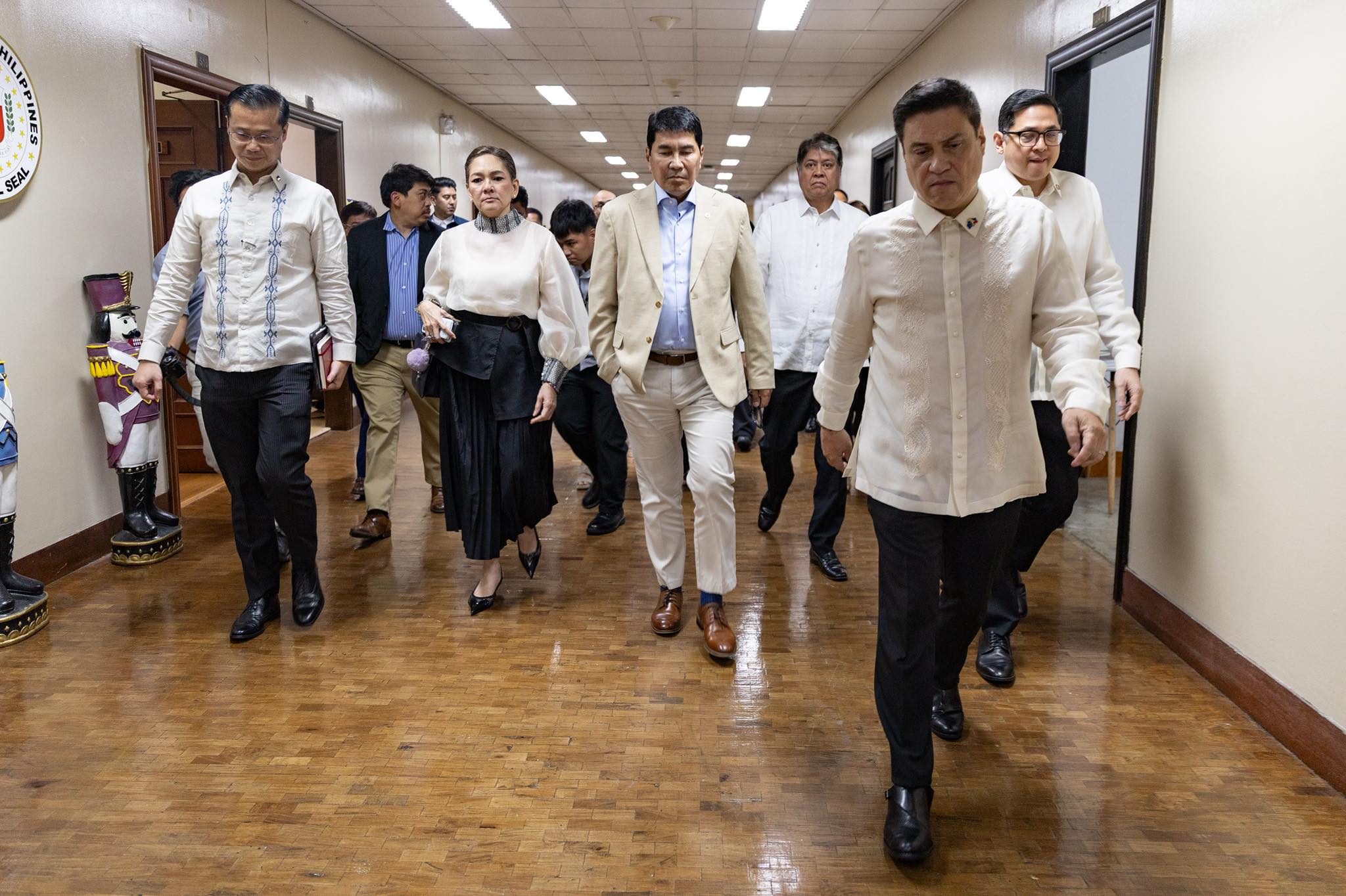
When Senate President Alan Peter Cayetano moved to “divide the house,” the minority bloc abruptly walked out of the session hall.
By withdrawing their physical presence, the minority intentionally collapsed the headcount.
With only 9 or 10 majority senators remaining on the floor, the chamber no longer possessed the 13 members required to legally conduct business.
The strategy was confirmed when former Senate President Tito Sotto—the only minority member who remained—immediately stood up and questioned the quorum.
“Umalis nga sila nag-walkout naiwan si Tito Sen para siyang mag-question ng quorum… Bakit mo in-invoke ang quorum? Eh alam mong mawawala ang quorum dahil umalis kayo eh.”
This maneuver effectively paralyzed the chamber, forcing the Senate President to adjourn the session without taking a vote on the remote attendance amendment.
SECTION IV: THE “LAW BENDER” NARRATIVE
Media Optics vs. Plenary Reality
In the aftermath of the walkout, a fierce battle for public perception erupted.
The minority bloc immediately engaged the mainstream media, framing the majority as a syndicate trying to “railroad” rules to protect criminals within their ranks.
The majority, however, struck back, focusing on the hypocrisy of the minority’s actions.
They pointed out that Senator Tulfo, who was part of the walkout, had previously gone on record stating that sometimes politicians must “bend the law” to please the people—earning him the moniker “Mr. Law Bender” among political commentators.
The majority argued that it is hypocritical for a bloc containing a self-proclaimed “law bender” to stage a walkout under the guise of protecting constitutional decorum.
Furthermore, the majority highlighted the constitutional duty of a senator to engage in debate.
“Bakit ka magwa-walkout?… Ang trabaho ng isang senador ay makipagtalastasan… Hindi po trabaho ng isang senador na pagkatapos mong mag-deliver ng privilege speech… tatakbo ka sa opisina mo pagkatapos pupunta ka sa media.”
The accusation is clear: the minority bloc is relying on media sympathy and social media theatrics because they lack the legal expertise and the voting numbers to win a legitimate debate on the Senate floor.
SECTION V: CONCLUSION — THE PARALYSIS OF THE PEOPLE’S HOUSE
The walkout in the Philippine Senate is a stark illustration of how procedural rules are being weaponized in the pursuit of factional survival.
The proposed amendment to Rule 14 is not merely an administrative update; it is a battleline drawn over the legal vulnerability of the majority coalition.
The minority’s decision to break the quorum was a successful tactical delay, but it comes at a high institutional cost.
By abandoning the floor to prevent a vote, they have set a dangerous precedent where minority factions can indefinitely paralyze the legislative branch whenever they face a losing vote.
As the Senate prepares to reconvene, the deadlock remains.
The majority is determined to push through the virtual attendance rule to protect their members, while the minority relies on walkouts and media pressure to block them.
Caught in the middle is the Filipino public, witnessing an institution that seems more focused on internal survival tactics and legal semantics than on the urgent business of the nation.
TECHNICAL APPENDIX & PARLIAMENTARY AUDIT
Senate Demographic Fact-Check: Regarding the “legal background” dispute, it is verified that only five (5) currently sitting senators have passed the Philippine Bar.
This demographic reality underscores the ongoing friction between the technical, law-centric approach to rule-making and the populist, media-centric approach.
Rule 14 (Section 41) Status: The current rule restricts virtual attendance to “force majeure” or “national emergency.” The proposed Section 41-C aims to lower this threshold to “justifiable reasons,” a term that currently lacks a strict legal definition within the Senate Rules.
Quorum Mechanics (Article VI, Sec.
16 of the Constitution): A majority of each House shall constitute a quorum to do business.
The walkout by the minority successfully weaponized this provision, utilizing their physical absence to legally invalidate any subsequent voting attempted by the remaining majority members.
Note: The events analyzed in this report are based on the plenary session proceedings and subsequent media statements from May 2026.